
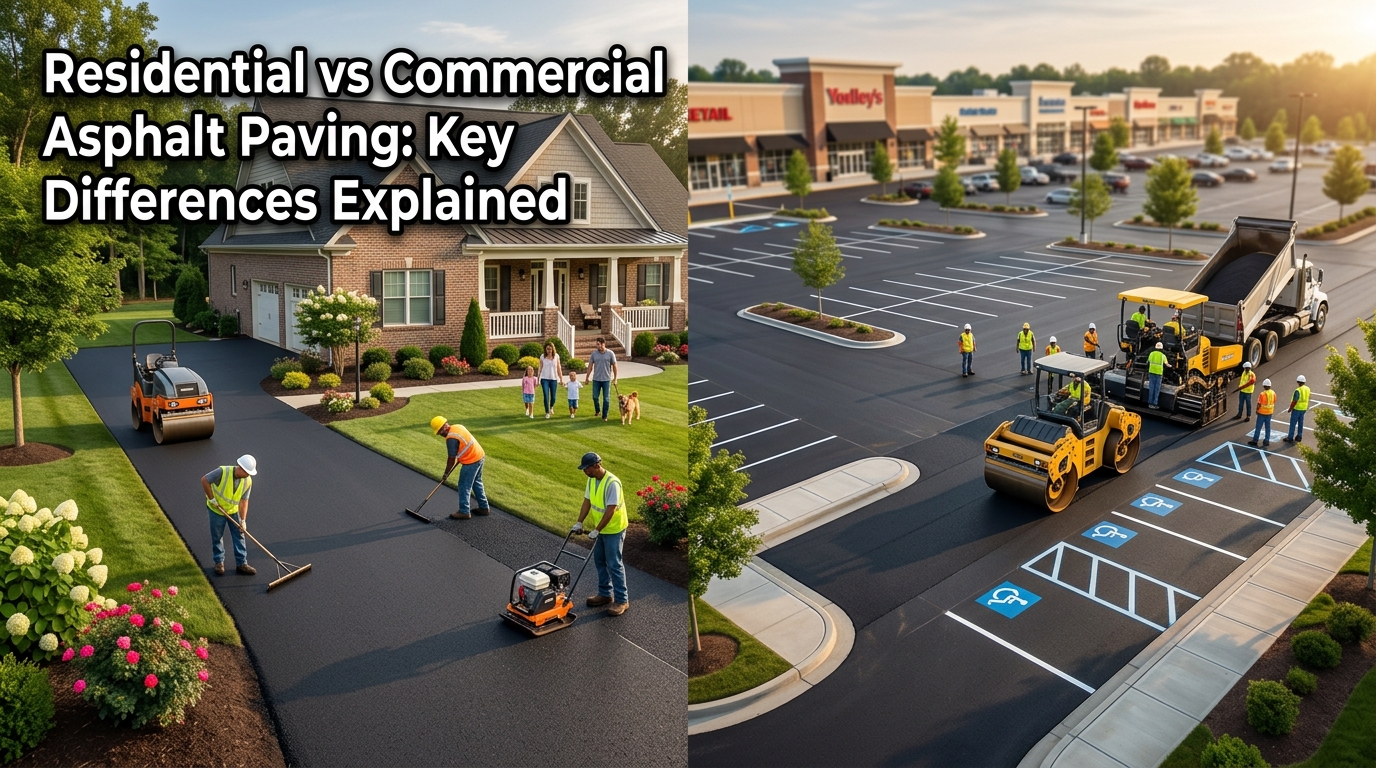
At a glance, asphalt is asphalt, a black, durable surface you park and drive on. But there’s a real difference between paving a home driveway and paving a commercial parking lot, and it goes well beyond size. The two projects call for different asphalt thickness, base preparation, equipment, materials, and planning, because they’re built to handle very different demands.
Whether you’re a homeowner planning a new driveway or a business owner responsible for a parking lot, understanding these differences helps you know what to expect, ask the right questions, and choose a contractor equipped for your specific job. Let’s break down exactly how residential and commercial asphalt paving differ, and why those differences matter for the durability, cost, and success of your project.
| → Whether it’s a home driveway or a commercial lot, Quality Paving builds it to the right spec. Serving homeowners and businesses across West Tennessee, call +1 731 927 1097 or request your free estimate. |
The Core Difference: Load and Traffic
Everything else flows from this one factor. A residential driveway typically supports a few passenger vehicles, cars, an SUV, maybe a light truck, driving over it a handful of times a day. A commercial parking lot may handle hundreds or thousands of vehicles daily, including delivery trucks, box trucks, and heavy equipment that put enormous stress on the surface.
Because the loads and traffic volumes are so different, commercial pavement has to be engineered to carry far more weight far more often. That fundamental difference shapes the thickness, base, and materials each project requires. Building a commercial lot to residential specs would fail quickly, and building a driveway to full commercial spec would waste your money.
Asphalt Thickness and Base Preparation
The most important differences are the ones you can’t see once the job is done. Residential and commercial projects use different depths of asphalt and base to match their loads.
A residential driveway generally uses a thinner asphalt layer over a compacted aggregate base sized for passenger vehicles. A commercial lot uses a thicker asphalt surface, often laid in multiple layers, over a deeper, more robust base engineered to carry heavy, repeated traffic. The base preparation for commercial work is more extensive because a failure under heavy load is far more costly.
Why the Base Matters Most
For both project types, the base beneath the asphalt is what determines longevity, but the stakes are higher commercially. A properly engineered and compacted base spreads the load and keeps the surface from cracking and rutting. Skimping on the base is the number one cause of premature failure in both residential and commercial pavement.
Equipment and Crew Size
The scale of the job dictates the equipment. A residential driveway can often be completed by a smaller crew with standard paving equipment in a day or two. A commercial lot requires larger pavers, heavier rollers, more crew, and careful logistics to move materials and machinery across a big site efficiently.
This is why it’s worth choosing a contractor who handles the type of project you have. A company experienced in both residential and commercial work has the equipment and know-how to scale appropriately, whether you need a single driveway or a full parking lot.
Drainage, Layout, and Design Complexity
Residential drainage is relatively simple: slope the driveway so water runs off toward the edges and away from the home. Commercial drainage is a bigger engineering task, large flat surfaces must be graded to move significant volumes of water to drains and catch basins without pooling, which takes careful planning.
Commercial projects also involve layout and design that residential ones don’t: traffic flow, parking space configuration, entrances and exits, and line striping. And commercial lots must account for ADA accessibility, properly marked accessible spaces, access aisles, and signage, which adds another layer of planning that home driveways don’t require.
Project Timeline and Scheduling
Timelines differ significantly. A residential driveway is often a one- or two-day job. A commercial parking lot can take several days to weeks depending on size and complexity, and often has to be phased so a business can keep operating while sections are paved.
For commercial clients, minimizing disruption is a real concern. An experienced commercial contractor plans the work to keep your business accessible, sometimes working in sections or during off-hours, so you’re not shut down while the lot is done.
| → Not sure what thickness or base your project needs? Our experienced team will spec it correctly for your use and site. Contact us for a free on-site evaluation. |
Cost Differences and What Drives Them
It’s no surprise that commercial paving costs more than residential, but the reason isn’t just size. Commercial projects require more material (thicker asphalt and deeper base), more equipment and labor, more complex drainage and layout, and compliance planning. All of that adds to the price per square foot compared to a straightforward driveway.
For residential projects, cost is driven mainly by size, base condition, and whether significant grading or drainage work is needed. In both cases, the only way to get an accurate number is an on-site estimate, a per-square-foot guess doesn’t account for the base condition and site specifics that actually drive the price.
Maintenance Needs Differ Too
Both residential and commercial asphalt benefit from sealcoating and crack filling, but commercial lots generally need maintenance on a more frequent schedule because of their heavier traffic. Regular upkeep protects the larger investment a commercial lot represents and keeps it safe and presentable for customers.
The core maintenance principles are the same, seal the surface, fill cracks early, keep it draining, but the frequency and scale scale up with the demands on the pavement. A good contractor can set you up with a maintenance rhythm suited to how your surface is used.
Materials and Mix: Not Always the Same
Beyond thickness, the asphalt mix itself can differ between residential and commercial jobs. Asphalt comes in different grades and aggregate blends, and the right mix depends on the traffic and loads the surface will carry. A commercial lot handling heavy trucks may call for a tougher, more durable mix engineered to resist rutting and wear under constant load.
A residential driveway can use a smoother, finer mix that looks great and holds up well under lighter passenger-vehicle use. Choosing the appropriate mix is part of what an experienced contractor does automatically, and it’s another reason a one-size-fits-all approach falls short. The material is matched to the job, not just poured from whatever’s on the truck.
Which Do You Need? Match the Job to the Contractor
The takeaway is simple: residential and commercial paving are related but distinct disciplines. A driveway needs a contractor who builds a clean, durable surface for passenger vehicles and knows local residential conditions. A parking lot needs a contractor who can engineer for heavy loads, complex drainage, layout, and compliance, and keep your business running during the work.
The ideal choice is a company experienced in both, so whether your project is a single home driveway or a sprawling commercial lot, it’s built to the right spec by a team that handles projects of every scale with the same care and precision.
Conclusion
Residential and commercial asphalt paving share the same basic material but serve very different demands. Commercial work calls for thicker asphalt, deeper bases, bigger equipment, and complex drainage, layout, and compliance planning, all driven by the heavy traffic it must endure. Residential paving is simpler and lighter, but still depends on a solid base and good drainage to last.
The key in both cases is matching your project to a contractor equipped to handle it. Whether you need a single driveway or a full parking lot, we’re set up to build it right, and we’re happy to walk you through exactly what your project requires.
| → From residential driveways to large commercial parking lots, Quality Paving handles every scale with the same precision. Call +1 731 927 1097 or get your free estimate today. |
Frequently Asked Questions
Q1. What is the difference between residential and commercial asphalt paving?
The main difference is load and traffic. Commercial paving uses thicker asphalt and a deeper, more robust base to handle heavy, high-volume traffic, plus more complex drainage, layout, striping, and ADA compliance. Residential paving is built for lighter passenger-vehicle use with a thinner surface and simpler design.
Q2. Is commercial asphalt thicker than residential?
Yes. Commercial asphalt is laid thicker, often in multiple layers, over a deeper engineered base because it must support heavy trucks and constant traffic. Residential driveways use a thinner surface for passenger vehicles.
Q3. Why does commercial paving cost more than residential?
Commercial paving requires more material, thicker asphalt and deeper base, plus larger equipment, more labor, complex drainage and layout, striping, and ADA compliance planning. These factors raise the cost per square foot compared to a straightforward residential driveway.
Q4. Can the same contractor do both residential and commercial paving?
Yes, if they have the equipment and experience for both. A contractor that handles both scales can build a durable home driveway or engineer a heavy-duty commercial lot, matching the right spec, crew, and equipment to each project.
Q5. How often should commercial asphalt be maintained?
Commercial lots generally need sealcoating and crack filling more frequently than driveways because of heavier traffic. Regular maintenance protects the larger investment and keeps the lot safe and presentable. A contractor can recommend a schedule based on your traffic volume.